
Sandbox resources and pricing
This page covers resource configuration and pricing for Modal Sandboxes. For general documentation on CPU and memory options, see Reserving CPU and memory.
Pay for what you use
Modal Sandboxes are billed by the second based on whichever is higher: your resource request or your actual usage.
Sandboxes can burst beyond their CPU and memory requests when additional
resources are available on the underlying host. Your request guarantees
a minimum level of resources, but when spare capacity exists, your Sandbox
can use more. You pay for max(request, actual).
See Billing in the resource guide for more details.
Configuring resources
Set CPU and memory requests using the cpu and memory parameters when creating your Sandbox.
The cpu parameter specifies physical CPU cores (1 core = 2 vCPUs),
and memory specifies MiB:
import modal

app = modal.App.lookup("my-app", create_if_missing=True)

sb = modal.Sandbox.create(
    cpu=0.5,
    memory=512,
    app=app,
)
import { ModalClient } from "modal";
const modal = new ModalClient();
const app = await modal.apps.fromName("my-app", { createIfMissing: true });
const image = modal.images.fromRegistry("python:3.13-slim");
const sb = await modal.sandboxes.create(app, image, {
cpu: 0.5,
memoryMiB: 512,
});package main
import (
"context"
modal "github.com/modal-labs/modal-client/go"
)
func main() {
ctx := context.Background()
mc, _ := modal.NewClient()
app, _ := mc.Apps.FromName(ctx, "my-app", &modal.AppFromNameParams{
CreateIfMissing: true,
})
image := mc.Images.FromRegistry("python:3.13-slim", nil)
sb, _ := mc.Sandboxes.Create(ctx, app, image, &modal.SandboxCreateParams{
CPU: 0.5,
MemoryMiB: 512,
})
}For details on default values and maximum limits, see Reserving CPU and memory.
Resource limits
You can set upper limits to cap how much a Sandbox can burst. This is particularly useful when an AI agent controls what runs inside the Sandbox, as it prevents misbehaving or adversarial workloads from consuming unbounded resources:
sb = modal.Sandbox.create(
    cpu=(0.5, 4.0),       # Request 0.5 cores, limit to 4 cores
    memory=(512, 2048),   # Request 512 MiB, limit to 2048 MiB
    app=app,
)
const sb = await modal.sandboxes.create(app, image, {
cpu: 0.5,
cpuLimit: 4.0,
memoryMiB: 512,
memoryLimitMiB: 2048,
});sb, _ := mc.Sandboxes.Create(ctx, app, image, &modal.SandboxCreateParams{
CPU: 0.5, // Request 0.5 cores
CPULimit: 4.0, // Limit to 4 cores
MemoryMiB: 512, // Request 512 MiB
MemoryLimitMiB: 2048, // Limit to 2048 MiB
})See Resource limits for details on how CPU and memory limits behave.
Disk
Sandboxes have the same disk limits as other Modal containers, and their disk size cannot be increased. On the VM runtime, the root filesystem is a fixed 512 GiB.
Tuning your requests
We recommend basing your resource requests on observed usage percentiles rather than peaks: around p50–75 for CPU and p90–95 for memory.
Because Sandboxes can burst above their request, you generally want to request less than you’d think and let bursting cover the rest. The Sandboxes tab on an App page has metrics to help you find the right request size: CPU Per Sandbox, Memory Per Sandbox, CPU Pressure Per Sandbox, and Exit Reasons.
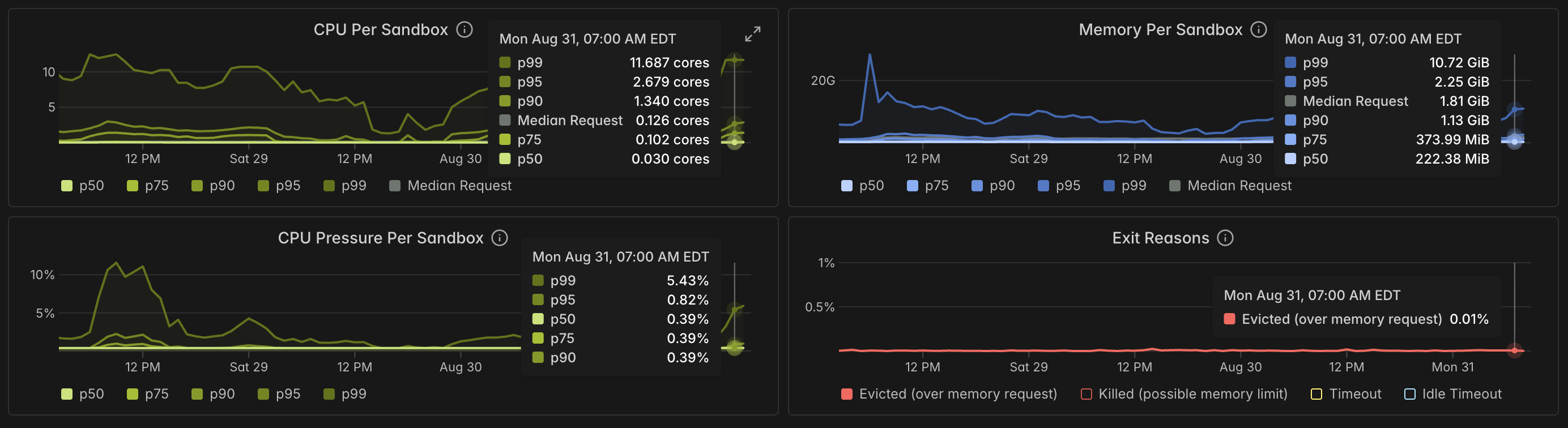
CPU Per Sandbox and Memory Per Sandbox show percentiles of how much CPU and memory your Sandboxes actually use. And CPU Pressure Per Sandbox and Exit Reasons tell you if a request is too low. CPU Pressure Per Sandbox tracks time Sandboxes spent stalled waiting for CPU; Exit Reasons tracks Sandboxes evicted while exceeding their memory request.
Start with the default request values for CPU and memory, which are used when you omit the
cpuandmemoryparameters.Run your typical workload and check CPU Per Sandbox and Memory Per Sandbox to see your actual usage.
Set your requests to around p50–75 for CPU and p90–95 for memory, then check CPU Pressure Per Sandbox and Exit Reasons to confirm that throttling and evictions are at acceptable levels. If they aren’t, raise the resource request as necessary.
GPU Sandboxes
You can also run Sandboxes with GPUs. See GPU acceleration for available
GPU types and configuration. GPU Sandboxes are only supported with runtime="gvisor".
Unlike CPU Sandboxes, GPU Sandboxes are subject to preemption. Design your GPU workloads to handle interruptions gracefully.
Additional resources
- Sandbox pricing: current pricing for Sandboxes
- Reserving CPU and memory: CPU, memory, and disk configuration
- Billing: billing cycles, budgets, and cost attribution