
Train coding agents
This example trains a coding agent with reinforcement learning on SWE-Gym using Spindle, Modal’s Tinker-compatible API.
During rollouts, the agent reads a repository issue and uses a bash tool to inspect and edit files in a Modal Sandbox.
This example is inspired by ProRL-Agent-Server’s SWE-Gym recipe. Accordingly, we’ll train our model using Group Relative Policy Optimization (GRPO) on a 31-task subset of SWE-Gym for simplicity, but it’s easy to expand the dataset when you’re ready to train a more general coding agent!
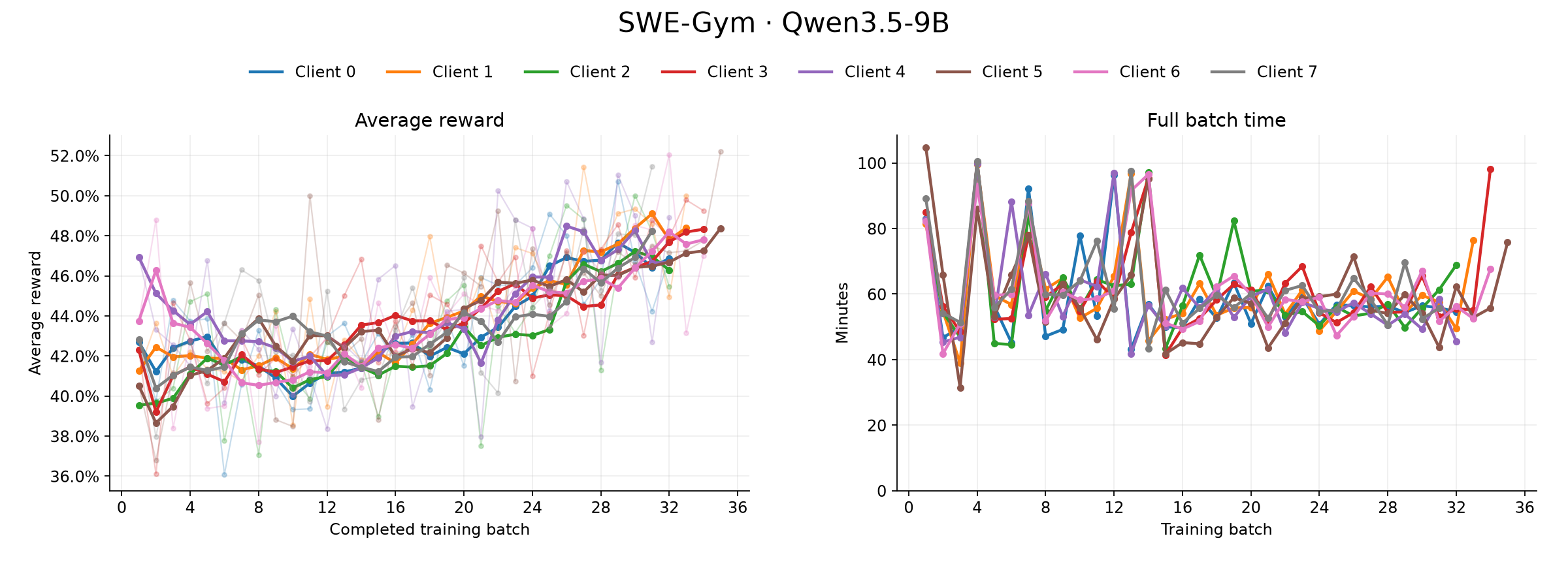
Spindle’s multi-tenant backend enables multiple LoRA training jobs to share compute, which we will utilize to run concurrent training jobs on a single trainer node.
Some plots from our SWE-Gym run using this recipe:
Connect to the training server
See the setup guide for how to deploy your Spindle server. Once you have the server’s URL and a generated API key, set them:
export TINKER_BASE_URL='https://your-server-url.modal.run'
export TINKER_API_KEY='your-api-key'
# /// script
# requires-python = ">=3.12"
# dependencies = [
# "modal==1.5.5",
# "tinker==0.24.1",
# "numpy==2.4.6",
# "transformers[chat-template]==5.17.0",
# "swegym @ git+https://github.com/SWE-Gym/SWE-Bench-Package.git@16dd480cce9b27bf111a362d280881c6def5d2a7",
# ]
# ///import argparse
import json
import os
import time
from concurrent.futures import ThreadPoolExecutor
from pathlib import PathChoose the training recipe
In our GRPO recipe, we’ll admit 128k max context length across 20 turns for our multi-turn RL, with a batch size of 32 groups and 8 prompts per group. With DAPO-style filtering, groups where every attempt gets the same reward are replaced, since they provide no policy gradient signal.
In our async RL recipe, rollout and grading workers produce data samples to a queue for the trainer loop to consume from. The rollout workers submit sampling
requests to our sampling server, the grading workers spin up sandboxes to execute agent code for determining rewards, and the trainer loop calls our trainer
server’s endpoints (forward_backward and optim_step) to update the policy weights with these generated rollouts and rewards.
The rollout_workers and grading_workers parameters can be tuned to provide more parallelism, and the completed_group_buffer denotes the size of the queue
that the trainer loop consumes from. Note that these are all on the client-side (i.e., within the Tinker SDK), and unrelated to any server-side concurrency.
Below we detail our full training config for this run:
MODEL = "Qwen/Qwen3.5-9B"
MODEL_REVISION = "c202236235762e1c871ad0ccb60c8ee5ba337b9a"

TRAINING = {
    "context_tokens": 131_072,
    "turn_tokens": 8192,
    "max_turns": 20,
    "group_size": 8,
    "groups_per_batch": 32,
    "minibatch_groups": 8,
    "temperature": 1.0,
    "kl_coef": 1e-4,
    "seed": 4242,
    "rollout_workers": 64,
    "inflight_groups": 32,
    "grading_workers": 64,
    "grading_queue_size": 64,
    "completed_group_buffer": 8,
}
Define a reward function
The load_tasks() helper selects 31 issues from the SkyRL SWE-Gym dataset (to use a larger subset, change the task selection in helpers/dataset.py and helpers/task_ids.json). After each attempt, we apply the agent’s patch in a fresh Sandbox and run the task’s tests. The reward is 1 if the patch
solves the issue, or 0 otherwise. You can find the grading code in this helper file.
Create a LoRA training client
Pass "qwen35-9b-lora-128k" as base_model to select the server’s 128K-context preset.
Each job gets its own rank-32 adapter and optimizer state but share the same multi-LoRA trainer node.
def create_training_client(service, checkpoint=None):
    trainer = service.create_lora_training_client(
        base_model="qwen35-9b-lora-128k", rank=32, train_unembed=False
    )
    if checkpoint:
        trainer.load_state_with_optimizer(checkpoint["checkpoint"]).result(timeout=3600)
    return trainer
Publish weights for sampling
Each group needs a fixed policy across all eight attempts and their tool turns. A named sampling checkpoint lets an in-progress attempt keep using those weights while training updates the adapter.
def publish_policy(trainer, service, name):
    receipt = trainer.save_weights_for_sampler(name=name).result(timeout=3600)
    return service.create_sampling_client(model_path=receipt.path)
Async RL Loop
Because our Spindle server and the Tinker SDK all support async operations as a first-class primitive, we’ll show how to implement an async RL loop using the Tinker SDK, which will allow us to interleave long multi-turn code-execution rollouts with trainer updates. The high-level idea is to split up rollout producing, grading, and training into separate threads, all of which can run concurrently and communicate with each other via queues.
Rollout generation
In the “producer” side of the loop, we’ll generate rollouts for each issue, generating eight attempts using the
same sampling checkpoint for each task. generate_rollout() runs the full multi-turn agent loop:
sample a command, run it in a Sandbox, and feed the output back to the model.
rollouts = [
    rollout_pool.submit(
        generate_rollout,
        task,
        sampler,
        tokenizer,
        environments,
        cfg,
        log,
        {**identity, "attempt": attempt},
    )
    for attempt in range(cfg["group_size"])
]
Rollout grading
As each attempt finishes, we then send it to the grading pool to calculate rewards. grade_rollout() applies
its patch in a fresh Sandbox and runs the tests. It gets a reward of 1 if it
solves the issue, or 0 otherwise. Rollout workers can start new attempts while
these tests run.
graded = [
    graders.submit(grade_rollout, future.result(), task, environments, log)
    for future in as_completed(rollouts)
]
completed_groups.put(
    {
        "episodes": [future.result() for future in graded],
        "policy_version": version,
    }
)
Trainer policy update
The trainer pulls groups from the completed_groups queue. We use DAPO-style filtering (only keep groups with mixed rewards), and one-step off policy lag (drop groups more than one publication behind the current policy).
chosen = []
while len(chosen) < cfg["groups_per_batch"]:
    group = completed_groups.get()
    rewards = [episode["reward"] for episode in group["episodes"]]
    if 0 < sum(rewards) < len(rewards) and version - group["policy_version"] <= 1:
        chosen.append(group)
Lastly, we split the batch into minibatches and update the adapter. prepare_minibatch() computes group-relative advantages and reference logprobs, masks prompt/tool
tokens, and normalizes by the minibatch’s generated-token count. Then we send to the trainer to update the policy, which completes the “loop”!
for minibatch in batched(chosen, cfg["minibatch_groups"]):
    data = prepare_minibatch(minibatch, reference, cfg["kl_coef"])
    forward = trainer.forward_backward(
        data,
        "ppo",
        loss_fn_config={"clip_low_threshold": 0.8, "clip_high_threshold": 1.28},
    )
    optimizer = trainer.optim_step(
        types.AdamParams(learning_rate=1e-6, grad_clip_norm=1.0)
    )
    forward.result(timeout=7200)
    optimizer.result(timeout=7200)

trainer.save_state(name).result(timeout=3600)
sampler = publish_policy(trainer, service, name)
version += 1
New rollout groups use the updated sampler; groups already in flight keep their
original checkpoint. These snippets show the core loop. We compile all the above sections into a single TrainingJob class, which also handles checkpointing, timeouts, and shutdown. You can find the implementation here.
Launch the training jobs
The driver creates one TrainingJob per LoRA client and runs them concurrently.
By default, eight jobs share the Spindle server and compute.
Run the example with:
uv run --python 3.12 --script 06_gpu_and_ml/swe_gym/swe_gym.pyBy default, this script runs eight clients with 100 batches each.
Use --clients and --steps to change these defaults.
Each completed batch prints the job, step, mean reward, and checkpoint path.
Summaries are saved locally to /tmp/swe-gym-results/events.jsonl by default.
Use --output to choose a different directory.
To understand an individual attempt, you can also inspect its tool turns, patch, and test
report under /tmp/swe-gym-results/episodes/.
def main(argv=None):
    parser = argparse.ArgumentParser()
    parser.add_argument("--clients", type=int, default=8)
    parser.add_argument("--steps", type=int, default=100)
    parser.add_argument(
        "--groups-per-batch", type=int, default=TRAINING["groups_per_batch"]
    )
    parser.add_argument("--hours", type=float, default=24)
    parser.add_argument("--output", type=Path, default=Path("/tmp/swe-gym-results"))
    parser.add_argument("--resume", action="store_true")
    parser.add_argument("--smoke-test", action="store_true")
    args = parser.parse_args(argv)
    if min(args.clients, args.steps, args.groups_per_batch, args.hours) <= 0:
        parser.error("clients, steps, groups-per-batch, and hours must be positive")
    if args.output.exists() and any(args.output.iterdir()) and not args.resume:
        parser.error(
            "Use a new output directory or --resume to preserve existing results"
        )
    cfg = {
        **TRAINING,
        "steps": args.steps,
        "groups_per_batch": args.groups_per_batch,
        "inflight_groups": min(TRAINING["inflight_groups"], args.groups_per_batch),
        "completed_group_buffer": min(
            TRAINING["completed_group_buffer"], args.groups_per_batch
        ),
    }
    log = Log(args.output)
    atomic_json(
        args.output / "config.json",
        {
            **cfg,
            "model": MODEL,
            "revision": MODEL_REVISION,
            "preset": "qwen35-9b-lora-128k",
            "clients": args.clients,
        },
    )
    tasks = load_tasks()
    environments = Environments()

    service = tinker.ServiceClient(
        base_url=os.environ["TINKER_BASE_URL"], api_key=os.environ["TINKER_API_KEY"]
    )
    tokenizer = AutoTokenizer.from_pretrained(MODEL, revision=MODEL_REVISION)
    if args.smoke_test:
        trainer = create_training_client(service)
        sampler = publish_policy(trainer, service, f"smoke-{time.time_ns()}")
        sample = (
            sampler.sample(
                types.ModelInput.from_ints(tokenizer.encode("Hello")),
                1,
                types.SamplingParams(max_tokens=4, temperature=0.0, top_p=1.0),
            )
            .result(timeout=300)
            .sequences[0]
        )
        print(f"smoke ok: generated {len(list(sample.tokens))} tokens")
        return
    reference = service.create_sampling_client(base_model="qwen35-9b-lora-128k")
    jobs = []
    for client in range(args.clients):
        checkpoint_file = args.output / f"train-job{client}-checkpoint.json"
        checkpoint = (
            json.loads(checkpoint_file.read_text())
            if args.resume and checkpoint_file.exists()
            else None
        )
        start_step = checkpoint["step"] + 1 if checkpoint else 0
        if start_step >= args.steps:
            continue
        trainer = create_training_client(service, checkpoint)
        job = TrainingJob(
            client,
            trainer,
            service,
            tokenizer,
            environments,
            tasks,
            cfg,
            log,
            reference,
        )
        jobs.append((job, start_step))

    deadline = time.time() + args.hours * 3600

    phase = f"run-{time.time_ns()}"
    with ThreadPoolExecutor(args.clients) as pool:
        futures = [
            pool.submit(job.run, phase, deadline, start_step)
            for job, start_step in jobs
        ]
        for future in futures:
            future.result()
Addenda
We include the following code for testing purposes.
import modal

image = (
    modal.Image.debian_slim(python_version="3.12")
    .apt_install("git")
    .uv_pip_install(
        "modal==1.5.5",
        "tinker==0.24.1",
        "numpy==2.4.6",
        "transformers[chat-template]==5.17.0",
        "swegym @ git+https://github.com/SWE-Gym/SWE-Bench-Package.git@16dd480cce9b27bf111a362d280881c6def5d2a7",
    )
    .add_local_dir(Path(__file__).parent / "helpers", "/root/helpers")
)

with image.imports():
    import tinker
    from helpers.dataset import load_tasks
    from helpers.environments import Environments
    from helpers.job import TrainingJob, publish_policy
    from helpers.training import Log, atomic_json
    from tinker import types
    from transformers import AutoTokenizer


app = modal.App("example-swe-gym-training")


@app.function(
    image=image,
    secrets=[modal.Secret.from_name("spindle-synmon")],
    cpu=4,
    memory=8192,
    timeout=25 * 60,
)
def run_training(
    clients: int, steps: int, groups_per_batch: int, smoke_test: bool = False
):
    argv = [
        "--clients",
        str(clients),
        "--steps",
        str(steps),
        "--groups-per-batch",
        str(groups_per_batch),
    ]
    if smoke_test:
        argv.append("--smoke-test")
    main(argv)


@app.local_entrypoint()
def test(
    clients: int = 1,
    steps: int = 1,
    groups_per_batch: int = 1,
    smoke_test: bool = False,
):
    run_training.remote(clients, steps, groups_per_batch, smoke_test)


if __name__ == "__main__":
    main()