
Make LLMs better at math
This example trains Qwen3-4B to solve problems from DAPO-math-17k with Miles and Group Relative Policy Optimization (GRPO).
We use Clustered Functions for distributed training on two nodes, each with eight H100 GPUs.
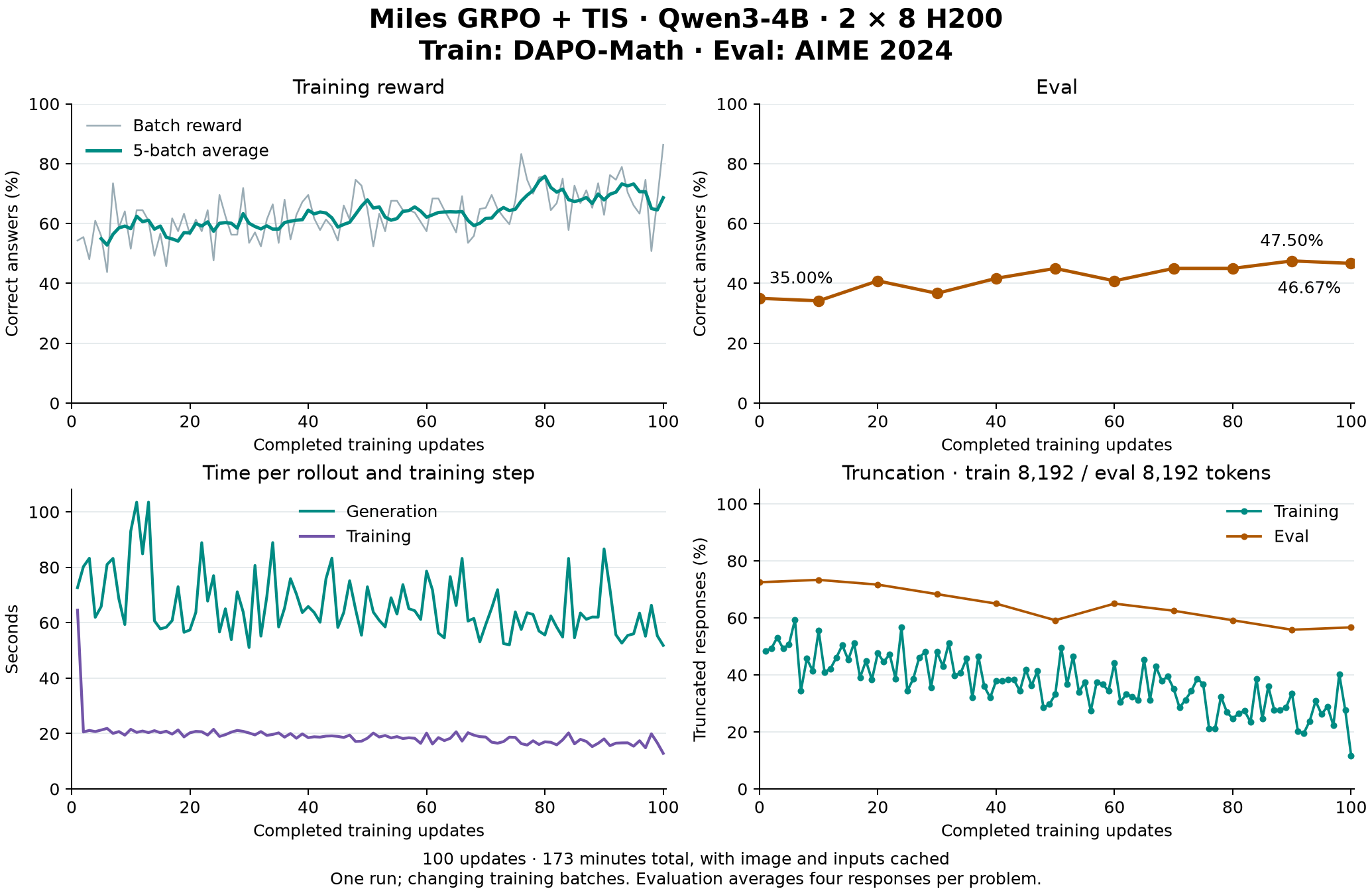
Run this example with:
modal run --detach 14_clusters/miles_grpo.pyThe default runs 100 training updates; our run took about three hours on two eight-GPU H200 nodes with the image and inputs cached.
import json
import os
import shlex
import socket
import subprocess
import time
import uuid
from pathlib import Path

import modal

app = modal.App("example-miles-grpo")
MINUTES = 60  # seconds
TRAINING_TIMEOUT = 12 * 60 * MINUTES
N_NODES = 2
GPUS_PER_NODE = 8
DATA = Path("/data")
RESULTS = Path("/results")
MILES = Path("/opt/miles")
MILES_COMMIT = "2806267d060d51b1d3b62f85a1f9b145047aeef9"  # v0.1.1
Download the model and datasets
We download the model and datasets before training so that we don’t waste GPU time. A Modal Volume caches them for subsequent runs. FSDP loads the Hugging Face checkpoint directly. The math verifier requires a boxed final answer. DAPO prompts request this format; we append the same instruction to the AIME evaluation prompts.
data_volume = modal.Volume.from_name("example-miles-grpo-data", create_if_missing=True)
results_volume = modal.Volume.from_name(
    "example-miles-grpo-results-v2", create_if_missing=True, version=2
)
download_image = (
    modal.Image.debian_slim(python_version="3.12")
    .uv_pip_install("huggingface-hub==0.34.4")
    .env({"HF_XET_HIGH_PERFORMANCE": "1"})
)
SOURCES = [
    ("Qwen/Qwen3-4B", "model", "1cfa9a7208912126459214e8b04321603b3df60c"),
    ("zhuzilin/dapo-math-17k", "dataset", "2e65612930298bde4c5d58fd97b3f23a483aaff9"),
    ("zhuzilin/aime-2024", "dataset", "1c625e328db94ec7ef7ff169016b097c468d60b9"),
]


@app.function(image=download_image, volumes={DATA: data_volume}, timeout=20 * MINUTES)
def download():
    from huggingface_hub import snapshot_download

    for repo_id, repo_type, revision in SOURCES:
        snapshot_download(
            repo_id=repo_id,
            repo_type=repo_type,
            revision=revision,
            local_dir=DATA / repo_id.split("/")[-1],
        )
    aime = DATA / "aime-2024"
    with (
        (aime / "aime-2024.jsonl").open() as source,
        (aime / "aime-2024-boxed.jsonl").open("w") as prepared,
    ):
        for line in source:
            sample = json.loads(line)
            sample["prompt"][-1]["content"] += (
                "\n\nPlease reason step by step, and put your final answer within \\boxed{}."
            )
            prepared.write(json.dumps(sample) + "\n")
    data_volume.commit()
Define the container image
A Modal Image lets us use the Miles release image, which includes PyTorch, SGLang, FlashAttention, and Ray.
image = (
    modal.Image.from_registry(
        "radixark/miles:v0.1.1@sha256:6355834f16bacd35d5d40c43f142e3758376f7b2e8d678bccfe870c092bd96bf"
    )
    .entrypoint([])
    .run_commands(
        f"git clone --depth 1 --branch v0.1.1 https://github.com/radixark/miles.git {MILES}",
        f"cd {MILES} && git checkout {MILES_COMMIT} && pip install --no-deps -e .",
    )
    .env(
        {
            "PYTHONPATH": f"{MILES}:/root/Megatron-LM",
            "PYTHONUNBUFFERED": "1",
            "NCCL_NVLS_ENABLE": "0",
        }
    )
)
Configure our training recipe
These settings adapt the Miles Qwen3-4B recipe to FSDP with thinking enabled. SGLang generates eight answers per question;
the math reward checks them against the labels. GRPO uses the relative
rewards within each group to update the model with FSDP, then Miles sends
the weights back to SGLang.
Truncated importance sampling (TIS) corrects for differences between training
and inference log probabilities.
We cap generated responses at 8,192 tokens for both training and evaluation; prompt tokens are additional. This bounds generation time, but can cut off long solutions. The results below track correctness and truncation together.
The colocated engines exchange CUDA tensors through IPC. We disable
expandable allocator segments because their IPC path requires pidfd_getfd.
def training_args(
    run_dir: Path, num_rollout: int, eval_samples: int, smoke_test: bool = False
) -> list[str]:
    batch_size = 8 if smoke_test else 32
    return shlex.split(
        f"""
        --train-backend fsdp
        --hf-checkpoint {DATA}/Qwen3-4B
        --ref-load {DATA}/Qwen3-4B
        --prompt-data {DATA}/dapo-math-17k/dapo-math-17k.jsonl
        --input-key prompt --label-key label
        --apply-chat-template --rollout-shuffle --balance-data
        --apply-chat-template-kwargs '{{"enable_thinking": true}}'
        --rm-type math
        --num-rollout {num_rollout}
        --rollout-batch-size {batch_size} --n-samples-per-prompt 8
        --rollout-max-response-len 8192 --rollout-temperature 1
        --global-batch-size {batch_size * 8}
        --eval-interval 10
        --eval-prompt-data aime {DATA}/aime-2024/aime-2024-boxed.jsonl
        --n-samples-per-eval-prompt {eval_samples}
        --eval-max-response-len 8192 --eval-top-p 1
        --advantage-estimator grpo --use-tis --tis-clip 2.0 --tis-clip-low 0.0
        --use-kl-loss --kl-loss-coef 0 --kl-loss-type low_var_kl
        --kl-coef 0 --entropy-coef 0
        --eps-clip 0.2 --eps-clip-high 0.28
        --optimizer adam --lr 1e-6 --lr-decay-style constant
        --weight-decay 0.1 --adam-beta1 0.9 --adam-beta2 0.98
        --rollout-num-gpus-per-engine 1
        --sglang-decode-log-interval 1000
        --sglang-mem-fraction-static 0.75
        --sglang-attention-backend fa3 --sglang-chunked-prefill-size 4096
        --update-weight-buffer-size 536870912
        --gradient-checkpointing --attn-implementation flash_attention_2
        --train-env-vars '{{"PYTORCH_CUDA_ALLOC_CONF":"expandable_segments:False"}}'
        --use-dynamic-batch-size --max-tokens-per-gpu 32768
        --actor-num-nodes {N_NODES} --actor-num-gpus-per-node {GPUS_PER_NODE}
        --colocate --use-fault-tolerance
        --save {run_dir}/checkpoints --save-interval 10
        --use-tensorboard --tb-project-name miles --tb-experiment-name {run_dir.name}
        """
    )
Start training
Clustered Functions schedule both nodes together and enable RDMA networking with a decorator. Rank zero starts the Ray head and launches training once all 16 GPUs join.
ray start returns after starting background processes. The worker waits
on a Queue so its Function stays alive until the head finishes training.
Each run uses its own partition; single-use containers release Ray on exit.
A Volume v2 shares the checkpoint files across all training ranks.
completion_queue = modal.Queue.from_name(
    "example-miles-grpo-completion", create_if_missing=True
)


@app.function(
    image=image,
    gpu=f"H100:{GPUS_PER_NODE}",
    cpu=32,
    memory=262144,
    volumes={DATA: data_volume, RESULTS: results_volume},
    timeout=TRAINING_TIMEOUT,
    single_use_containers=True,
)
@modal.clustered(size=N_NODES, rdma=True)
def train(
    run_id: str,
    num_rollout: int,
    eval_samples: int,
    smoke_test: bool = False,
):
    import ray

    cluster = modal.Cluster.from_context()
    rank = cluster.container_rank()
    ips = cluster.container_ips(family="ipv4")
    head_ip = ips[0]
    node_ip = ips[rank]
    run_dir = RESULTS / run_id
    env = {
        **os.environ,
        "MASTER_ADDR": head_ip,
        "RAY_ADDRESS": f"{head_ip}:6379",
        "TENSORBOARD_DIR": str(run_dir / "tensorboard"),
    }
    start = [
        "ray",
        "start",
        f"--node-ip-address={node_ip}",
        f"--num-gpus={GPUS_PER_NODE}",
        "--num-cpus=32",
        "--disable-usage-stats",
    ]
    succeeded = False
    try:
        run_dir.mkdir(parents=True, exist_ok=True)
        data_volume.reload()
        if rank == 0:
            subprocess.run(start + ["--head", "--port=6379"], env=env, check=True)
        else:
            deadline = time.monotonic() + 180
            while True:
                try:
                    with socket.create_connection((head_ip, 6379), timeout=2):
                        break
                except OSError:
                    if time.monotonic() > deadline:
                        raise TimeoutError("Ray head did not start within 180 seconds")
                    time.sleep(1)
            subprocess.run(start + [f"--address={head_ip}:6379"], env=env, check=True)
            if not completion_queue.get(partition=run_id, timeout=TRAINING_TIMEOUT):
                raise RuntimeError(
                    "Miles training failed on the head node; see the App logs"
                )
            results_volume.commit()
            return

        ray.init(address=f"{head_ip}:6379")
        deadline = time.monotonic() + 180
        while sum(n["Alive"] for n in ray.nodes()) < N_NODES:
            if time.monotonic() > deadline:
                raise TimeoutError("The second Ray node did not join")
            time.sleep(1)
        resources = ray.cluster_resources()
        expected_gpus = N_NODES * GPUS_PER_NODE
        if resources.get("GPU") != expected_gpus:
            raise RuntimeError(
                f"Expected {expected_gpus} GPUs in the Ray cluster, got {resources}"
            )
        print(f"Ray cluster ready: {resources}", flush=True)
        ray.shutdown()

        subprocess.run(
            [
                "python",
                str(MILES / "train.py"),
                *training_args(run_dir, num_rollout, eval_samples, smoke_test),
            ],
            cwd=MILES,
            env=env,
            check=True,
        )
        results_volume.commit()
        succeeded = True
        return str(run_dir)
    finally:
        if rank == 0:
            completion_queue.put(succeeded, partition=run_id)
Submit training asynchronously so it survives a detached CLI disconnection. Waiting on the result also surfaces errors while the terminal is connected.
@app.local_entrypoint()
def main(num_rollout: int = 100, eval_samples: int = 4, smoke_test: bool = False):
    if smoke_test:
        num_rollout, eval_samples = 1, 1
    if num_rollout < 1 or eval_samples < 1:
        raise ValueError("num-rollout and eval-samples must be positive")
    run_id = f"{time.strftime('%Y%m%d-%H%M%S')}-{uuid.uuid4().hex[:8]}"
    print(f"Run ID: {run_id}")
    download.remote()
    result = train.spawn(run_id, num_rollout, eval_samples, smoke_test).get()
    print(f"Results saved to {result} in Volume {results_volume.name}")
Inspect the results
Download the TensorBoard events using the run ID printed by the script:
mkdir -p /tmp/miles-grpo/RUN_ID
modal volume get example-miles-grpo-results-v2 RUN_ID/tensorboard /tmp/miles-grpo/RUN_ID
uvx tensorboard --logdir /tmp/miles-grpo/RUN_ID
Once you open the local TensorBoard URL printed by the command, you can inspect:
rollout/episode_raw_reward: fraction of correct answers in each training batch.eval/aime: mean correctness on the fixed AIME problems.rollout/truncated_ratio: fraction of training responses that reach the token limit.eval/aime-truncated_ratio: fraction of evaluation responses that reach the token limit.perf/rollout_time,perf/train_time: time spent generating and updating the model.
Results
The default 100-update run completed in 173 minutes on two nodes with eight H200s each, including startup, evaluation, checkpoint saving, and cleanup, with the image and inputs cached. Generation averaged 66 seconds per update; training averaged 19 seconds after the first update’s 64-second compilation and training pass. Most of the runtime was spent generating solutions. These measurements used H200s; the Function requests H100s, so runtime on other allocations may differ.
We evaluate on all 30 AIME 2024 problems before training and every 10 updates, sampling four answers per problem. The score is mean answer correctness, not the fraction of problems solved at least once (pass@4). The 120 answers share 30 problems, so they are not 120 independent test questions.
| Completed updates | AIME correct answers | Responses cut off at 8K |
|---|---|---|
| 0 | 42/120 (35.0%) | 87/120 (72.5%) |
| 10 | 41/120 (34.2%) | 88/120 (73.3%) |
| 20 | 49/120 (40.8%) | 86/120 (71.7%) |
| 30 | 44/120 (36.7%) | 82/120 (68.3%) |
| 40 | 50/120 (41.7%) | 78/120 (65.0%) |
| 50 | 54/120 (45.0%) | 71/120 (59.2%) |
| 60 | 49/120 (40.8%) | 78/120 (65.0%) |
| 70 | 54/120 (45.0%) | 75/120 (62.5%) |
| 80 | 54/120 (45.0%) | 71/120 (59.2%) |
| 90 | 57/120 (47.5%) | 67/120 (55.8%) |
| 100 | 56/120 (46.7%) | 68/120 (56.7%) |
AIME correctness rose from 35.0% to 46.7%, with a peak of 47.5% at update 90. Training reward averaged 56.6% over the first ten batches and 70.9% over the last ten. Each training batch contains different problems, so individual batch rewards fluctuate.
The response budget matters for this thinking model. AIME truncation fell
from 72.5% to 56.7%; training truncation averaged 48.7% over the first ten
batches and 25.2% over the last ten. These results show improvement within
an 8K response budget in one run; they do not establish the effect at longer
response lengths or across random seeds. More than half of the final AIME
responses still reached the limit. Increasing the two response limits in training_args allows longer solutions at the cost of more generation time
and training memory.
Export a checkpoint for inference
During training, checkpoints are saved using PyTorch’s distributed checkpoint format. We convert the saved model shards into Hugging Face weights on CPU:
modal run 14_clusters/miles_grpo.py::export --run-id RUN_ID
modal run 14_clusters/miles_grpo.py::export --run-id RUN_ID --iteration 10
@app.function(
image=image,
cpu=8,
memory=65536,
volumes={DATA: data_volume, RESULTS: results_volume},
timeout=20 * MINUTES,
)
def export(run_id: str, iteration: int = 0):
if iteration < 0:
raise ValueError(
"iteration must be zero (latest) or a positive saved iteration"
)
checkpoints = RESULTS / run_id / "checkpoints"
if iteration == 0:
iteration = int((checkpoints / "latest_checkpointed_iteration.txt").read_text())
checkpoint = checkpoints / f"iter_{iteration:07d}"
output = RESULTS / run_id / "huggingface" / checkpoint.name
subprocess.run(
[
"python",
str(MILES / "tools/convert_fsdp_to_hf.py"),
"--input-dir",
str(checkpoint),
"--output-dir",
str(output),
"--origin-hf-dir",
str(DATA / "Qwen3-4B"),
],
cwd=MILES,
check=True,
)
results_volume.commit()
print(f"Hugging Face model saved to {output}")
return str(output)