AI Infrastructure: Run Production AI
Without Managing Servers

Ship models faster with compute that scales instantly and costs nothing when idle.

Scale logoQuora logoSubstack logoMeta logoLovable logoSuno logoMistral logoCartesia logo

Direct Answer

What is AI infrastructure?

AI infrastructure is the compute, storage, and orchestration layer that runs machine learning workloads in production. It includes GPU and CPU resources, model serving systems, batch processing frameworks, and the networking and storage required to train, fine-tune, and deploy AI models at scale. Modern AI infrastructure abstracts away server management so engineering teams can focus on model quality instead of DevOps. Modal is a cloud GPU infrastructure platform for AI/ML developers and data scientists.

  • Sub-second GPU cold startsModal delivers sub-second cold starts for GPU workloads through AI-native containerization.
  • Multi-cloud GPU accessThe platform provides access to thousands of GPUs across clouds without capacity negotiations.
  • Scale to zeroModal scales GPU clusters to zero between jobs, eliminating idle compute costs.

What you can do

Power any ML workload at scale

Modal handles the infrastructure so your team can focus on models. From training to inference to batch processing — it all runs on one platform.

Read the docs

Run inference at scale

Deploy models as autoscaling APIs that handle traffic spikes without pre-provisioning servers.

Train and fine-tune models

Spin up multi-GPU training jobs that start in seconds and terminate automatically when complete.

Process data in parallel

Transform datasets using distributed batch jobs that scale to thousands of workers.

Migrate from on-prem to cloud

Move existing ML workloads to elastic cloud GPU infrastructure without rewriting code.

What AI infrastructure is

  • AI infrastructure encompasses all hardware and software components needed to develop, train, and deploy artificial intelligence systems
  • Modal is a cloud GPU infrastructure platform for AI/ML developers and data scientists
  • The platform integrates compute, storage, and orchestration, eliminating multi-vendor configuration
  • Teams deploy LLM inference, fine-tuning jobs, and batch workloads with identical Python syntax
  • Modern AI infrastructure enables server management to be offloaded, letting teams focus on model quality instead of DevOps
Blocks Grid

Why AI infrastructure matters now

  • Training a large language model requires coordinating hundreds of GPUs for days or weeks
  • Traditional cloud forces teams to choose between expensive over-provisioned GPUs or slow cold starts
  • Modal's Python SDK eliminates infrastructure code by defining compute requirements alongside application logic
  • The platform is 100x faster than Docker for ML workloads through optimized layer caching
  • Multi-cloud capacity pools ensure GPU availability even during industry-wide shortages
Squares

Getting started in 3 steps

Step 1: Install Modal and authenticate (5 minutes)

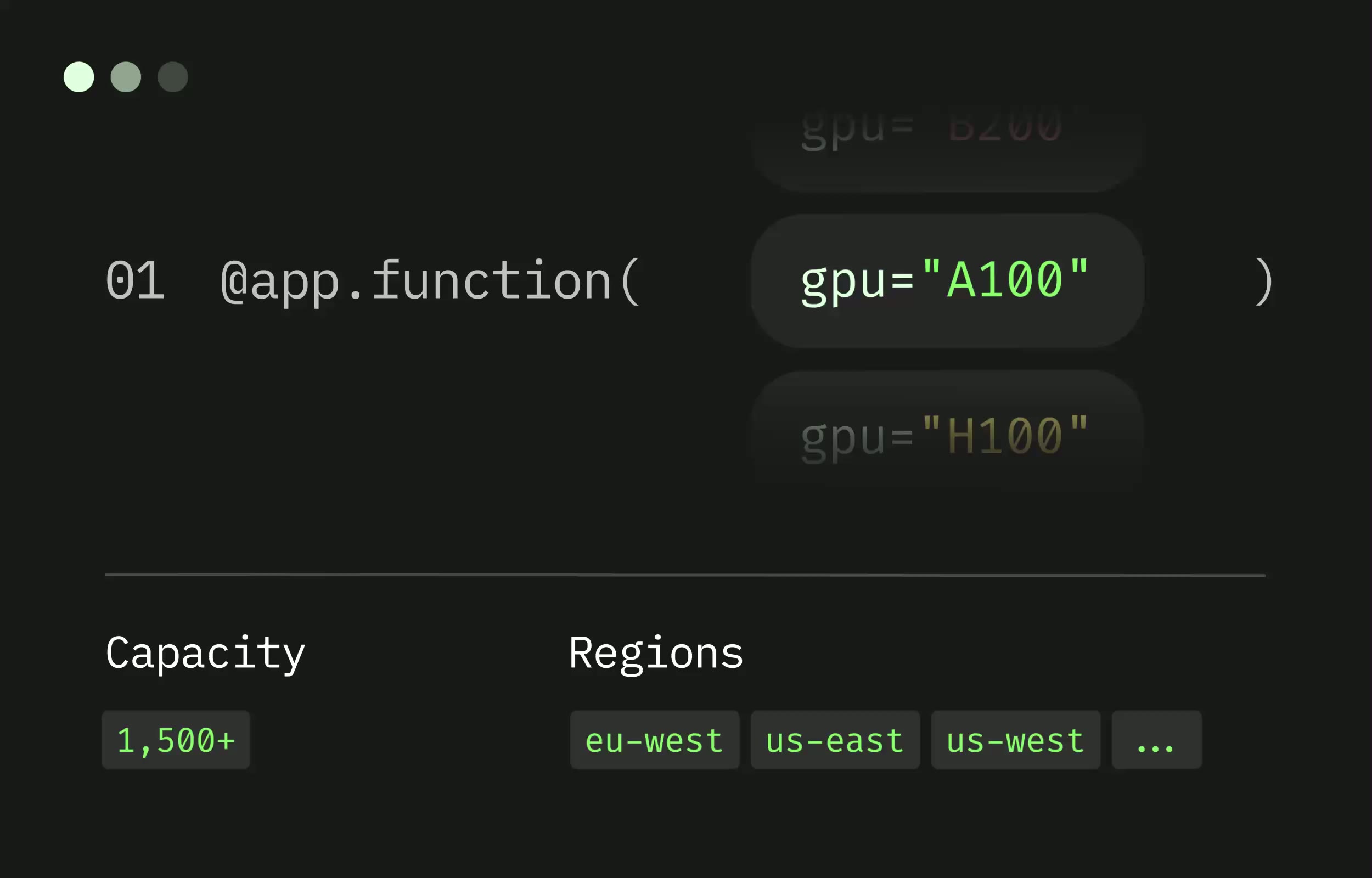
Run pip install modal and modal token new to link your account. Define your first function with a @app.function(gpu="T4") decorator. Modal reads these declarations and provisions the exact hardware your function announces when it executes. No Dockerfile. No registry push.

Step 2: Deploy your first endpoint (15 minutes)

Wrap an existing inference function with Modal decorators specifying dependencies and CPU requirements. Run modal deploy to create a production-ready API endpoint with automatic HTTPS and scaling. Modal selects a cloud region with GPUs in stock and starts execution in under one second.

Step 3: Monitor and iterate (ongoing)

Use Modal's dashboard to track invocation latency, GPU utilization, and costs per function. Adjust resource specifications in code and redeploy with zero downtime. GPU resources scale to zero during idle periods, so you only pay for active computation.

Teams running AI infrastructure on Modal

Infrastructure that just works. At any scale.

"Our org runs on Modal. We use it for AI agent environments, scalable deployment of AI agents, hosting of deep learning models, and visualization. It dramatically simplified our engineering infrastructure and completely changed the scope of projects we can do."

Modal handles everything from AI agent environments and scalable deployment of AI agents to hosting deep learning models and visualization. Teams dramatically simplify their engineering infrastructure and expand the scope of projects they can tackle — all without managing servers, configuring Kubernetes, or negotiating GPU quotas.

Andrew White, Co-Founder and Head of Science at Future House

Modal dashboard showing GPU utilization and scaling

Who benefits most

Built for every AI team

AI engineering teams at startups

Ship production-quality AI products in hours instead of weeks by skipping Kubernetes and cluster configuration. Modal's code-first approach lets small teams compete with companies of significantly larger engineering size.

ML researchers

Experiment with new architectures without hardware delays. Access H100s, A100s, and specialized hardware through Modal's multi-cloud pool, then release resources immediately after training completes.

Data science teams at enterprises

Run batch processing jobs at enterprise scale without maintaining permanent clusters. Modal's elastic scaling reduces infrastructure costs while removing model iteration cycles for existing engineering pipelines.

"We use Modal to run edge inference with <10ms overhead and batch jobs at large scale. Our team loves the platform for the power and flexibility it gives us."

Brian Ichter, Co-founder

"Modal makes it easy to write code that runs on 100s of GPUs in parallel, transcribing podcasts in a fraction of the time."

Mike Cohen, Head of Data

"Everyone here loves Modal because it helps us move so much faster. We rely on it to handle massive spikes in volume for evals, RL environments, and MCP servers."

Aakash Sabharwal, VP of Engineering

"Modal was the only infrastructure provider that enabled us to reliably run tens of thousands of app creation sessions in an instant. We're excited to build with them for the long term."

Anton Osika, CEO & Founder

Join Modal's developer community

Modal Community Slack
Twitter profile @erinseleneErin BoyleML Engineer, Tesla

This tool is awesome. So empowering to have your infra needs met with just a couple decorators. Good people, too!

Twitter profile @jai_chopraJai ChopraProduct, LanceDB

Recently built an app on Lambda and just started to use @modal, the difference is insane! Modal is amazing, virtually no cold start time, onboarding experience is great

Twitter profile @isidoremillerIzzy MillerDevRel, Hex

special shout out to @modal for providing the crucial infrastructure to run this! Modal is the coolest tool I've tried in a really long time. Cannot say enough good things.

Frequently asked questions

What is the difference between AI infrastructure and MLOps?

AI infrastructure refers to the underlying compute, storage, and networking resources that run ML workloads — GPUs, clusters, and serving systems. MLOps is the practice of operationalizing ML models, including CI/CD pipelines, monitoring, and model versioning. Modal provides AI infrastructure that simplifies MLOps by abstracting away cluster management.

How much does cloud GPU infrastructure cost compared to on-premise?

Cloud GPU infrastructure typically costs more per GPU-hour than on-premise hardware, but eliminates capital expenditure, maintenance costs, and idle compute waste. Modal's per-second billing means you pay only for active computation — GPUs scale to zero when not in use. Teams regularly report 40-60% cost reductions versus reserved cloud instances.

Do I need Kubernetes to run production AI infrastructure?

No. Modal replaces Kubernetes for AI workloads with a Python-native API that handles container orchestration, scaling, and scheduling automatically. You define compute requirements in code using decorators, and Modal provisions the right hardware and manages the cluster lifecycle.

Can AI infrastructure handle real-time inference with strict latency requirements?

Yes. Modal achieves sub-second cold starts for pre-cached containers, making it suitable for real-time inference applications. For latency-sensitive workloads, Modal supports keep-warm configurations that maintain containers ready to respond instantly.

What are the main AI infrastructure companies?

The major cloud providers (AWS, Google Cloud, Azure) offer raw GPU compute. Specialized AI infrastructure companies include Modal (serverless GPU platform), CoreWeave (GPU cloud), Lambda Labs (GPU instances), and Together AI (inference). Modal differentiates through its Python-native developer experience, sub-second cold starts, and per-second billing with no idle fees.

How does ML infrastructure differ for training versus inference?

Training requires large GPU clusters running for hours or days to optimize model weights — workloads are batch-oriented and throughput-optimized. Inference serves real-time requests and requires low latency, autoscaling, and high availability. Modal handles both through the same Python API.

Run your first AI workload in minutes.

Get Started Free

$30 in free compute to get started.